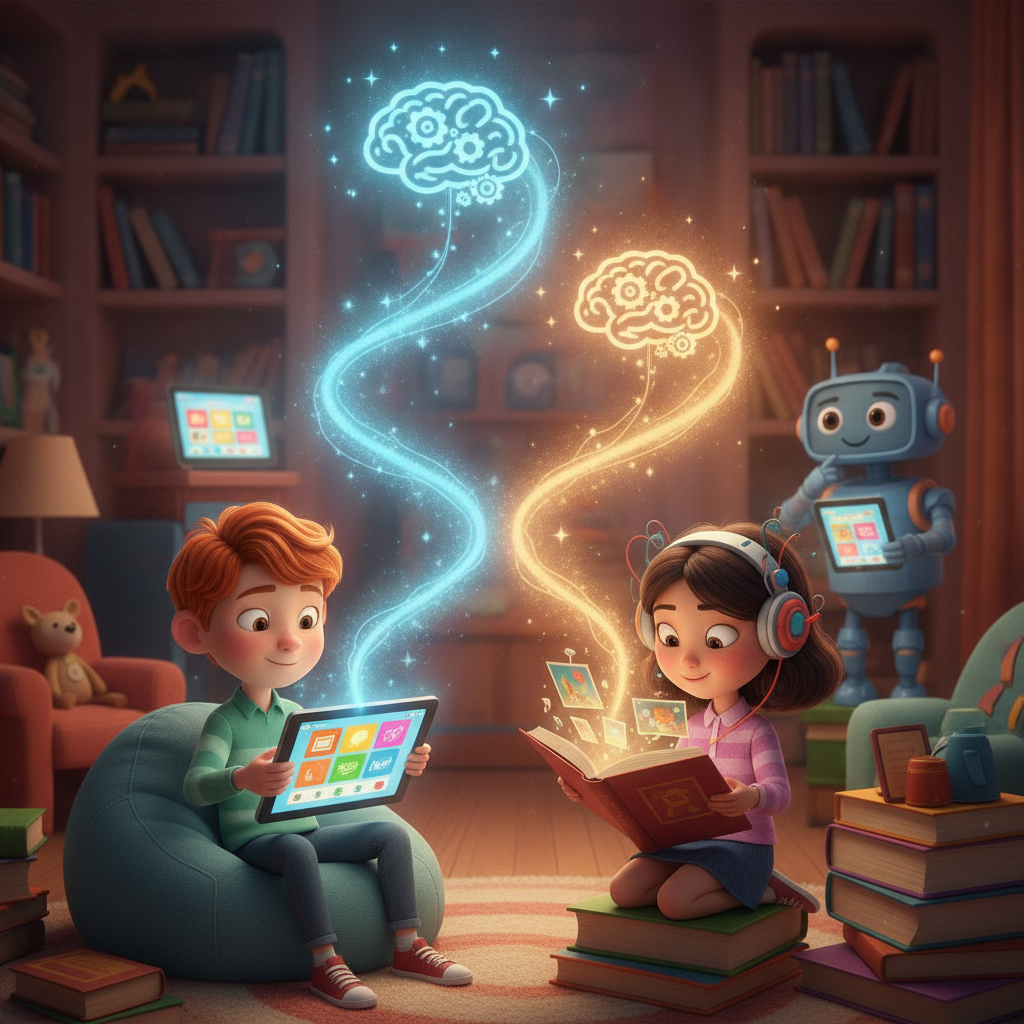
It is 8:30 PM. You have had an exhausting day, and your little one is curled up next to you, clutching a tablet. You want them to read, but you dread the inevitable shift from “reading a book” to tapping furiously on a colorful game.
We have all been there, feeling that familiar pang of parent guilt. We want to embrace the convenience of digital libraries, but we worry if these flashing, noisy screens are shortening our children’s attention spans.
The good news is that you do not have to banish screens entirely to protect your child’s cognitive development. It turns out, your parental instinct is spot on: there is a massive, scientifically proven difference between reading an interactive “game-book” and reading a clean, distraction-free PDF.
To understand why **digital books for kids** can either help or hurt brain development, we have to look at how the brain learns to read. Unlike speech, reading is not a natural human instinct; the brain must build brand-new neural pathways to translate symbols into meaning.
When children read interactive ebooks—those filled with animations, sound effects, and mini-games—their brains experience what psychologists call **cognitive overload**. Instead of focusing on the story, their brains are constantly distracted by “hotspots” that demand to be clicked.
Pediatric research shows that while kids might find these interactive elements highly engaging, their **reading comprehension actually plummets**. They are not visualizing the story or processing vocabulary; they are simply waiting for the next digital reward.
When we read on a screen, we naturally tend to scan rather than read deeply. However, when a PDF retains the exact formatting, page layout, and visual boundaries of a physical book, the brain can map the text spatially. This spatial mapping is a critical component of reading comprehension and memory retention.
In contrast, reading a static PDF is the closest digital equivalent to holding a physical paper book. Because PDFs lack distracting bells and whistles, they force the brain to do the heavy cognitive lifting of imagination, critical thinking, and language processing.
By choosing static PDFs over gamified apps, you are actively strengthening your child’s **prefrontal cortex**, which is the command center for focus, emotional regulation, and deep comprehension.
If you want to use digital devices for reading, make the conscious choice to bypass “app stores” filled with gamified storybooks. Instead, download simple, clean **PDF books** that require your child to focus solely on the words and static illustrations.
This simple shift changes the entire reading experience. Without flashing rewards, your child’s brain naturally calms down, allowing them to enter a state of **deep reading** that is essential for long-term literacy success.
Think of a clean PDF as a calm harbor in a stormy digital sea. By eliminating the temptation to tap, swipe, and trigger loud sounds, you are teaching your child how to sustain attention on a single task. This skill of deep, sustained focus is one of the greatest cognitive gifts you can give them.
The absolute best way to supercharge your child’s brain development during digital reading is through active, shared interaction. You can easily turn a simple PDF into a rich, interactive learning experience using the **PEER method**:
This conversational loop builds vocabulary much faster than any automated sound effect ever could. It turns screen time into a warm, relational bonding experience that supports both intellectual and emotional growth.
One of the biggest hurdles with digital reading is that kids know their favorite games are just a swipe away. To combat this, you need to establish clear, physical and digital boundaries around reading time.
Before handing your tablet to your child, activate **Guided Access** (on iOS devices) or **App Pinning** (on Android devices) to lock them into the PDF reader.
By preventing them from hopping over to YouTube or mobile games, you teach their developing brains that **reading time is a sacred, focused space** that requires a different mental pace than play time.
Let’s be honest: as busy parents, we do not have hours to search the internet for safe, high-quality, ad-free PDFs. It is incredibly frustrating to download a file only to find it is poorly formatted, pixelated, or riddled with hidden links.
That is exactly why we created our curated library of **PDF Kids Fables**. We wanted to provide parents with an instant, stress-free alternative to noisy, overstimulating screen time.
Our fables are beautifully designed, rich in moral lessons, and entirely free from distracting digital clutter. They are perfect for reading together on a tablet during bedtime, or you can print them out to create your own physical bedtime folders.
If you want to transition your child away from addictive apps and back into the joy of focused, imaginative storytelling, take a look at our complete collection of PDF Kids Fables today. It is the easiest way to turn screen time into high-quality brain-building time.