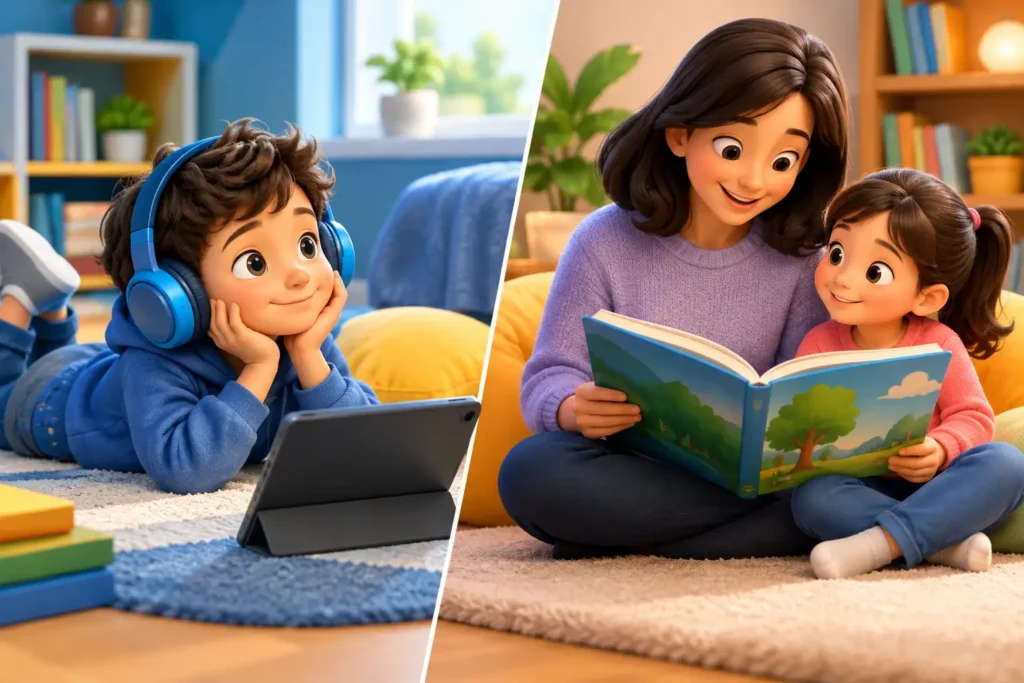
The lights are low, the pajamas are on, and your child asks for one more story. On an especially busy evening, pressing play can feel like a gift. On another, opening a book together feels like the only way to slow the day down. When parents consider audiobooks versus readalouds, the best choice is rarely about which format is “better.” It is about what your child needs in that moment: connection, comfort, independence, language practice, or simply a peaceful path to sleep.
Both options can help children grow into thoughtful listeners and readers. Yet they offer different kinds of support, especially for preschoolers and early elementary students who are still building attention, vocabulary, and emotional understanding.
Audiobooks Versus Readalouds: The Essential Difference
A readaloud is a shared experience. A parent, grandparent, teacher, or older sibling reads the words while the child listens, looks at the pages, asks questions, and responds. The adult can slow down for an unfamiliar word, change voices for a silly character, or pause when a story raises a big feeling.
An audiobook is a recorded performance. It may include a skilled narrator, character voices, music, or sound effects. Children can listen while resting, drawing, traveling, or following along in a printed or digital book. It gives families access to stories even when an adult cannot sit and read aloud.
Neither format is a shortcut around literacy. Listening to stories helps children hear rich language, follow a sequence of events, and imagine people and places beyond their immediate world. The difference is that a live readaloud creates a conversation around the story, while an audiobook gives children more practice listening independently.
What Children Gain From Being Read To
Reading aloud is one of the simplest ways to make a child feel seen at the end of a long day. Your voice is familiar. Your pauses tell them that their thoughts matter. Even a short story can become a dependable signal: now we are safe, together, and ready to rest.
This interaction also supports comprehension in ways a recording cannot always match. If your child asks, “Why did she do that?” you can talk through the character’s choice. If a lesson about honesty, kindness, or fairness feels close to something that happened at school, you can gently connect the story to real life. Those small conversations help children move beyond remembering what happened and begin thinking about why it mattered.
Readalouds are especially helpful for children who are still learning how books work. As you point to a title, turn pages, notice pictures, and occasionally track the words, your child learns that print carries meaning. They also hear how fluent reading sounds: where a sentence ends, how dialogue changes, and how expression brings a story to life.
You do not need a dramatic storyteller’s voice to make this meaningful. Warmth matters more than performance. A few minutes of unhurried attention can turn bedtime reading into a treasured family ritual.
Where Audiobooks Shine
Audiobooks deserve a place in many children’s routines. They are practical, engaging, and often wonderfully accessible. A child who struggles to decode words independently can still enjoy a story with a richer plot or more advanced vocabulary than they could read alone. That access protects the joy of stories while their reading skills continue to develop.
They can also be a welcome option when life is full. Play a gentle story during a car ride, a quiet afternoon, or while your child settles in after school. For a caregiver with a sore throat, a packed evening, or several children needing attention, an audiobook keeps story time available rather than letting it disappear altogether.
A well-narrated audiobook can model pacing, pronunciation, and expressive language. Children often notice how a narrator makes a worried character sound different from a proud or excited one. This can strengthen listening skills and help children recognize emotions in speech.
For some children, especially those who are reluctant readers, audiobooks lower the pressure. They can become absorbed in a tale without worrying about sounding out every word correctly. The goal is not to replace reading practice. It is to keep a child’s relationship with books positive, inviting, and full of possibility.
The Trade-Offs to Consider
The most useful question is not whether audiobooks count as reading. They absolutely support literacy. The better question is what may be missing if they become the only kind of story experience.
When an audiobook plays in the background, it is easier for a child’s attention to drift. Younger children may benefit from listening alongside an adult or following the pages in a book. Afterward, one simple question such as “What was your favorite part?” can help them process the story rather than merely hear it.
Audiobooks also do not automatically create the back-and-forth conversation that builds deeper understanding. A recording cannot notice a puzzled face, wait for a child’s prediction, or reassure them after a scary scene. If a story includes a moral lesson, a caring adult helps bring that lesson into focus.
Readalouds have trade-offs, too. They require time, energy, and a willing adult. Some nights, the familiar request for another chapter can feel difficult when everyone is tired. It is okay for your routine to be flexible. A bedtime practice that works most nights is more valuable than an ideal plan that creates stress.
A Gentle Way to Use Both at Bedtime
Many families find that the strongest routine includes both formats, each used with intention. You might reserve live reading for the final ten or fifteen minutes before sleep, when closeness and calm are most needed. Save audiobooks for afternoons, travel, quiet play, or nights when the usual routine needs support.
Another approach is to pair them. Listen to one chapter of an audiobook together, then read a short picture book aloud. Or read the first part of a story yourself and let your child listen to the next section the following day. This variety keeps listening fresh and shows children that stories can be enjoyed in more than one way.
For bedtime, choose recordings carefully. A fast pace, loud sound effects, or suspenseful plot may energize some children when they need to wind down. Gentle narration, shorter chapters, and reassuring endings are often a better fit. A timer can be helpful, too, so the story supports sleep instead of stretching the evening indefinitely.
If you are reading aloud, invite participation without turning story time into a quiz. Try asking what your child thinks a character should do, or whether they have ever felt the same way. When a story highlights kindness, humility, diligence, or honesty, one quiet question can carry its message further: “What do you think that character learned?”
Choose the Format That Meets the Moment
A child who has had a hard day may need the comfort of your lap and your voice. A child who is home sick, riding in the car, or eager to hear a longer adventure may be perfectly served by an audiobook. A beginning reader may benefit from holding the book while listening, then trying a familiar page aloud with you later.
Pay attention to your child’s response. Do they ask questions? Repeat favorite phrases? Retell the story during play? Those are encouraging signs that the story is landing. If they lose interest, it may not mean they dislike books. The story may be too long, the language too difficult, the timing wrong, or the format a poor match for that day.
For educators, audiobooks can support a listening center or provide access to a shared class story. Readalouds remain especially valuable for modeling expressive reading and guiding thoughtful discussion. In both settings, stories with clear emotional stakes and meaningful choices give children something worthwhile to talk about.
The real gift is not perfection or a certain number of pages each night. It is helping children learn that stories are a place to rest, wonder, and practice being a good friend, a brave problem-solver, and a thoughtful member of the family. Whether the next voice they hear is yours or a narrator’s, make room for a moment afterward to share a smile, a thought, or a lesson worth carrying into tomorrow.

The Baker and the Brave: Inner Beauty Story for Kids (PDF)
Egon is a large snow leopard who enjoys baking berry pies. The Baker and the Brave is a picture book about inner beauty for ages 3-8. Includes one 12-page illustrated English PDF. Download after purchase to read on screen or print. No physical book is shipped.



-

Same and Different Worksheets for Ages 4-5: Dinosaur Egg Lab (Printable PDF)
$2.99 Add to cart -
Seahorse Seagrass Days: 30 Printable Seahorse Coloring Pages for Ages 3-8 (PDF)
$3.99 Add to cart -
Easy Mazes for Ages 3-4: Duckling Pond Paths (Printable PDF)
$2.99 Add to cart -
Octopus Reef Days: 30 Printable Octopus Coloring Pages for Ages 3-8 (PDF)
$3.99 Add to cart