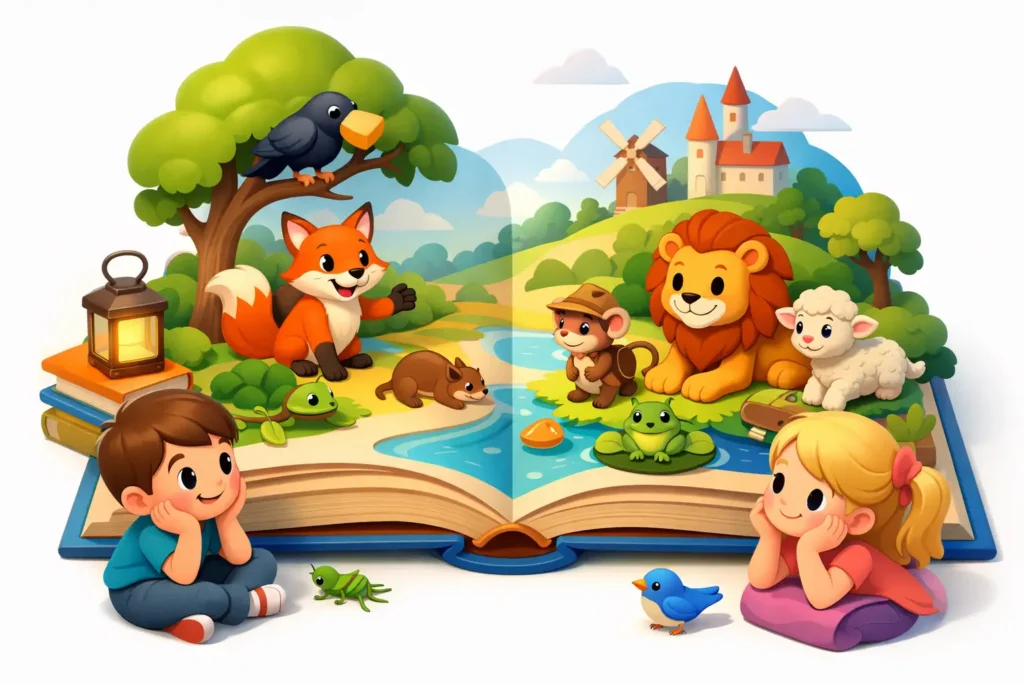
A child who refuses to split the last cookie is not necessarily being selfish. They may be tired, hungry, worried there will not be enough, or still learning that another person’s happiness matters too. That is why the best fables for sharing are so helpful at bedtime: they give children a little distance from the lesson. Instead of being told what they should have done, they can wonder what a fox, mouse, bird, or lion might do next.
Fables are short enough for busy evenings, yet their characters and consequences stay with children long after the lights are out. A well-chosen story can open a gentle conversation about taking turns, offering help, being fair, and noticing when someone else has a need. The goal is not to make a child feel guilty. It is to help them practice kindness one small choice at a time.
A dog carrying a bone sees his reflection in the water and thinks another dog has an even bigger bone. He snaps at the reflection, drops his own bone, and loses it. This familiar fable is especially useful for talking about greed and gratitude.
For young children, keep the conversation simple: “What did the dog already have?” Then ask, “How might he have felt if he had been thankful for his own meal?” The lesson is not that children can never want something. It is that grabbing for more can make us overlook what we have and what we could share.
A lion spares a tiny mouse who later frees him from a hunter’s net. The mouse could not offer the lion a toy or a snack, but she shared something just as valuable: her help. This story expands a child’s understanding of sharing beyond possessions.
Ask your child what they could share when a friend is sad or needs help. A kind word, a turn with a favorite game, or help cleaning up are all meaningful forms of generosity.
An ant falls into a stream, and a dove drops a leaf into the water so the ant can climb aboard. Later, the ant warns the dove of danger. The fable shows that thoughtful help can travel in both directions.
This is a lovely choice for children who are beginning to understand friendship. The dove does not help because she expects a reward. She sees someone in trouble and acts. That makes the later kindness from the ant feel even more meaningful.
A fox invites a stork to dinner but serves soup on a flat plate, knowing the stork cannot eat it. The stork later serves food in a tall jar, which the fox cannot enjoy. While the story has a playful edge, its deeper lesson is fairness.
Children often understand fairness before they fully understand generosity. You might ask, “Was the meal prepared in a way both guests could enjoy?” This can lead naturally to conversations about sharing games, choosing activities, and making sure everyone has a chance to join in.
Two travelers promise to help each other if danger comes. When a bear appears, one climbs a tree and leaves the other behind. The traveler on the ground survives by lying still, and afterward says the bear advised him not to trust a friend who abandons him.
This fable is less about sharing toys and more about sharing responsibility. It helps children see that friendship includes showing up, keeping promises, and not leaving someone alone when things become difficult. For preschoolers, connect it to simple moments: staying with a buddy on the playground or helping a sibling pick up blocks.
A father gives each of his sons a single stick, which they break easily. Then he ties a bundle of sticks together, and none of them can break it. The message is that people are stronger when they work together.
Sharing often requires cooperation. Children may need to share materials during an art project, take roles in a game, or work together to build a blanket fort. This fable reminds them that teamwork is not about giving something up. It can help everyone create something better.
In some collections, this story appears as a variation of The Ant and the Dove. The focus remains worth repeating: one small act of care can protect another living being. Younger children often enjoy hearing the story from the dove’s point of view, noticing how she pauses to look down and sees the ant struggling.
Use this version to encourage awareness. Sharing begins when a child notices that someone is left out, has no crayons, or cannot reach a turn in a game. Kindness is often simply paying attention.
Two goats meet on a narrow bridge over a deep stream. Neither wants to move aside, and both charge forward, falling into the water. The lesson is clear: stubbornness can hurt everyone.
This is one of the best fables for sharing when children are learning to take turns. It gives adults a calm, memorable phrase for everyday disagreements: “Do we want to be like the goats, or can we make room for each other?” Sharing does not always mean one child gets everything they want. Sometimes it means both children bend a little.
A thirsty crow finds a pitcher with a little water at the bottom. Unable to reach it, he drops pebbles into the pitcher until the water rises. The crow’s patience and problem-solving are the main lessons, but the tale also works well in conversations about resourcefulness.
When there is only one item children want, help them think of solutions together. Could they set a timer? Could one use it while the other chooses a different activity? Could they make a game that includes both? Sharing becomes easier when children learn that problems can have more than one answer.
A farmer catches a stork in a net set for cranes that have been eating his crops. The stork pleads that he is not like the cranes, but the farmer explains that he was caught among them. Older elementary-age children can use this fable to talk about choices and influence.
Its connection to sharing is subtle but useful. Children learn from the people around them. Choosing friends who are considerate, and being the friend who includes others, shapes a caring community in the classroom and at home.
A wolf asks a crane to remove a bone stuck in his throat. Once the crane helps him, the wolf refuses a reward and claims the crane should be grateful to have escaped unharmed. This story teaches children that generosity should never be exploited.
That is an important balance. Sharing is kind, but children also need to know they may say no when something feels unsafe, unfair, or hurtful. A child does not have to hand over a special comfort item, accept unkind behavior, or keep giving to someone who never respects them.
A farmer’s goose lays a golden egg each day. Wanting all the gold at once, the farmer harms the goose and loses the daily gift forever. Like The Dog and the Bone, this fable helps children understand that wanting more is not the same as needing more.
Try connecting the lesson to enoughness. When children feel secure that there will be another snack, another turn, and another chance to play, sharing can feel less frightening. Reassurance from a caring adult matters just as much as the moral of the story.
The story is only the beginning. After reading, choose one question rather than turning bedtime into a quiz. “Who was kind?” “What could that character have done differently?” or “When did you share something today?” are enough to invite reflection.
It also helps to name the exact behavior you hope to see. “You let your brother choose the first book. That was fair,” teaches more than a general reminder to be nice. Children learn character through repetition, encouragement, and chances to try again.
Not every fable will fit every child or every moment. A child struggling with turn-taking may respond best to The Two Goats, while a child who gives too much to please others may need The Wolf and the Crane. Choose the lesson that meets your child where they are.
A short, purposeful story can make bedtime feel both peaceful and meaningful. Whether you read a beloved classic or choose a ready-to-download moral story from Bed Time Kids Fables, let the final question be gentle: “What is one kind thing we can share tomorrow?”
Our books