A child who asks for a story about a clever fox may be looking for more than a few minutes of entertainment. They may be practicing how to handle a difficult feeling, make a fair choice, or imagine a world larger than their own. That is why the question of moral stories versus fairy tales matters to parents, grandparents, and educators. Both can make bedtime feel magical, but they often support children in different ways.
The good news is that you do not have to choose one kind of story forever. A thoughtful reading routine can make room for wonder, laughter, courage, and clear life lessons. The best choice often depends on your child’s age, temperament, and what they are working through right now.
A moral story is built around a lesson children can carry into daily life. The characters may be animals, children, families, or imagined creatures, but their choices lead naturally to a meaningful outcome. A child might see how honesty repairs a mistake, how kindness changes a lonely moment, or how patience helps someone reach a goal.
The lesson does not need to feel like a lecture. In fact, children respond best when the message grows out of the plot. If a young rabbit learns to share because a friend showed generosity first, the child can understand the value through the rabbit’s experience rather than being simply told to share.
This is especially helpful at bedtime. The quiet moments after a story give children space to talk about feelings, choices, and situations that may have happened during their own day. A short question such as, “What would you have done?” can open a gentle conversation without making a child feel questioned or corrected.
Moral stories are often a strong fit when a family is focusing on a particular value. If siblings have been arguing, a story about fairness or unity can offer a fresh perspective. If a child is nervous about admitting a mistake, a story about honesty can make bravery feel possible. The goal is not perfect behavior by morning. It is to give children language, examples, and encouragement they can return to over time.
Fairy tales usually lead with imagination. They may include enchanted forests, talking animals, castles, magical helpers, impossible tasks, and dramatic transformations. Their roots are often found in oral storytelling traditions, which is one reason they can feel so memorable and timeless.
Many fairy tales contain lessons, but the lesson is not always stated plainly. A child may notice that courage matters, that greed has consequences, or that a small, overlooked character can succeed. Yet the story’s main pull is often the adventure: What will happen in the dark woods? Will the spell be broken? Can the youngest child solve the riddle?
That sense of wonder is valuable. Fairy tales help children stretch their imagination and explore big emotions at a safe distance. A frightening giant, a jealous queen, or a difficult journey can represent fears and challenges that children recognize, even if they cannot yet put them into words. When the story ends safely, children may feel reassured that hard moments can be faced.
Still, not every traditional fairy tale will suit every child or every evening. Some have intense scenes, outdated messages, or plots that reward characters for traits you may not want to emphasize. A sensitive preschooler may find a threatening villain too upsetting before sleep, while an older child may be ready to discuss the story’s darker choices. It depends on the child and on how the story is presented.
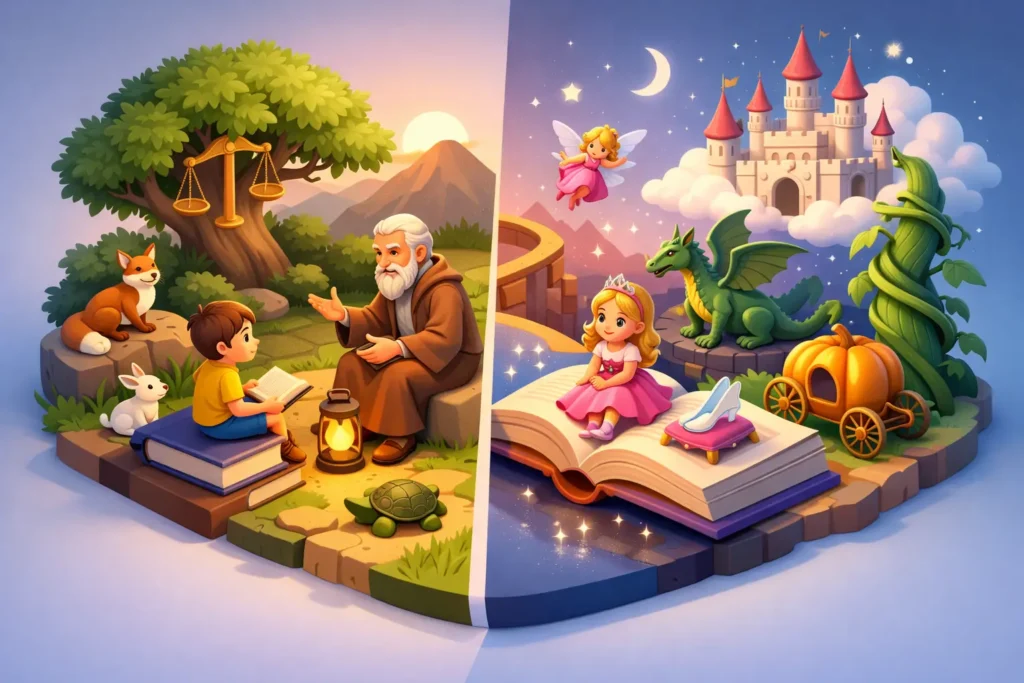
The clearest difference is purpose. Moral stories usually guide children toward a specific value through a simple, relatable situation. Fairy tales often invite children into a symbolic adventure where meaning can be discovered in several ways.
Neither approach is better in every situation. Moral stories can be especially useful when adults want to reinforce a value with clarity. They are often shorter, easier for young listeners to follow, and well suited to a predictable bedtime routine. Fairy tales can be wonderful when a child craves imagination, enjoys rich storytelling, or is ready to think about courage, justice, and change in a more open-ended way.
Consider a child who has been reluctant to include a new classmate in play. A moral story about kindness may show exactly how one welcoming gesture affects another child. A fairy tale might show a lonely traveler receiving help from an unexpected friend. Both stories can start a meaningful conversation, but the first offers a direct model while the second leaves more room for interpretation.
That distinction matters for early learners. Young children are still building the ability to connect abstract ideas to real-life choices. A clear lesson can help them make that connection. As children grow, more layered tales can help them practice empathy, prediction, and thoughtful discussion.
Rather than asking which type of story is best, ask what your child needs at this moment. A child who has had a frustrating day may benefit from a gentle moral story about persistence. A child who is restless and playful may settle into a fairy tale filled with imaginative details. A child who keeps requesting the same story may be returning to a feeling or lesson that still matters to them.
A few simple cues can guide your choice:
Length matters, too. A tired child does not always need a grand quest with many characters. Short stories can be deeply meaningful, especially when read slowly and warmly. A five-minute story with one clear emotional moment may do more for a child’s sense of connection than a longer story rushed through at the end of a busy night.
Adults sometimes worry that a moral story will feel too instructional. The answer is not to avoid the lesson. It is to let the child lead part of the conversation.
After reading, try reflecting on the character instead of immediately applying the message to your child. You might say, “That was a hard choice for the bear,” or, “I noticed the friends listened to each other.” These observations are warm and open. They invite a child to respond without pressure.
If your child wants to connect the story to real life, listen first. A child may say, “That happened at school,” or, “My brother did that.” This is a chance to validate feelings and gently explore alternatives. When children feel seen, the lesson becomes more than a rule. It becomes a tool for understanding themselves and others.
Fairy tales can be discussed in the same way. Ask what the child noticed, what felt brave, or which part seemed unfair. You do not need to explain every symbol or solve every message. Wonder has its own educational value. It helps children ask questions, imagine possibilities, and build confidence in their own ideas.
A well-loved story collection does not need to fit into only one category. Moral stories offer focused encouragement for the everyday moments children are learning to navigate. Fairy tales offer imagination, emotional exploration, and the delight of the unexpected. Together, they can make reading time feel both comforting and alive.
For younger children, begin with stories that have simple plots, gentle conflict, and an easy-to-understand outcome. As their attention and emotional vocabulary grow, introduce more complex fairy tales and ask broader questions. There is no need to rush. Re-reading favorites is part of how children absorb language, build security, and make meaning.
At Bed Time Kids Fables, the heart of bedtime reading is not simply finishing another book before the lights go out. It is creating a small, dependable moment where children feel close to the adults who love them and inspired by the choices characters make.
Tonight, choose the story that meets your child where they are. Whether it brings a clear lesson or a little magic, the quiet conversation that follows may become the part they remember most.