
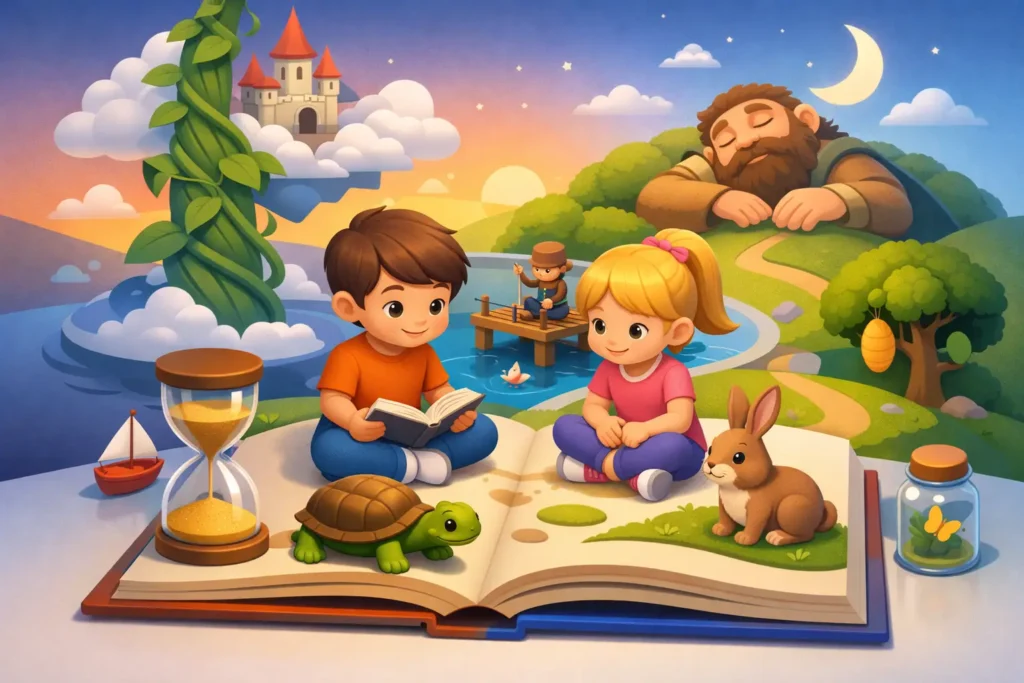
A child who asks, “Is it my turn yet?” for the fifth time is not trying to make life difficult. Waiting is a skill that grows slowly, through many small experiences. The best stories teaching patience give children a safe way to see that struggle, laugh at it, and practice a better response before the next wait at home, school, or the playground.
At bedtime, patience stories can do more than settle the room. They help children put words to big feelings: disappointment when something takes too long, frustration when a task feels hard, and hope that steady effort can bring a good result. The goal is not to expect young children to wait perfectly. It is to help them learn that waiting, trying again, and staying calm are all things they can practice.
12 Best Stories Teaching Patience
1. The Tortoise and the Hare
This familiar fable remains one of the clearest lessons in patient effort. The hare rushes ahead because he is sure he cannot lose, while the tortoise keeps moving at a slow, steady pace. The tortoise wins not through speed, but by continuing when the work is still unfinished.
Looking for a calming bedtime activity?
Download our soothing coloring storybooks — 30+ delightful printable pages for children ages 3–8. Ready to print instantly for only $17.00!
For preschoolers and early elementary readers, this story opens a gentle conversation about taking their time. Ask, “What did the tortoise do when the race felt long?” Then connect it to something real, such as learning to tie shoes, sound out a word, or clean up a big set of blocks.
2. The Little Red Hen
In this classic tale, a hen finds a grain of wheat and patiently does the work of planting, cutting, grinding, and baking. Her neighbors repeatedly decline to help, but they quickly appear when the bread is ready. The story is often taught as a lesson in responsibility, yet it also shows that worthwhile things take time and care.
This is especially helpful for children who want instant results. Baking, gardening, and learning all involve steps that cannot be skipped. If the ending feels too stern for your family, focus less on who deserves the bread and more on the hen’s steady commitment to finishing what she began.
3. Stone Soup
Stone Soup is a warm choice for teaching that good things can grow gradually when people contribute. In most versions, travelers begin with an empty pot and a stone, then encourage a community to add vegetables, seasonings, and other ingredients. What starts as very little becomes a shared meal.
Children can see that patience is not always lonely waiting. Sometimes it means allowing a group project, friendship, or family plan to come together one small piece at a time. After reading, ask what each person in the story added and why every contribution mattered.
4. The Empty Pot
In this Chinese folktale retelling, a boy named Ping receives a seed from the emperor and cares for it faithfully. Although nothing grows, he keeps watering and tending the pot. When the children return with beautiful flowers, Ping brings his empty pot and tells the truth. The emperor reveals that the seeds had been cooked and could never grow.
Nurture kindness & empathy tonight
Explore our gentle moral bedtime fables for children ages 3–8. Heart-warming character-building stories ready to read instantly for only $17.00!
The story beautifully joins patience with honesty. Ping does not get the result he hoped for, but he still does the right thing. It can reassure children that effort matters, even when the outcome is not what they expected.
5. The Carrot Seed
This simple, tender picture-book story follows a child who plants a carrot seed. Family members say it will not come up, but the child continues to water the ground and pull away weeds. At last, the carrot grows.
Its quiet rhythm makes it especially suited to bedtime. There is no villain and no big commotion, only a child caring for something day after day. For a young listener, that calm persistence can be more powerful than a lecture about waiting.
6. The Ant and the Grasshopper
The ant gathers food while the grasshopper spends warm days singing and playing. When winter arrives, the grasshopper has not prepared. The original fable can feel harsh, so choose an age-appropriate retelling, especially one that leaves room for compassion and learning.
Used thoughtfully, this story teaches that patience includes preparing for later instead of choosing only what feels fun right now. For children, that may mean putting toys away before starting another game or practicing a skill a little at a time. Keep the conversation balanced: planning ahead is wise, and helping someone who has made a mistake is kind.
7. The Three Little Pigs
The three little pigs build homes with straw, sticks, and bricks. The pig who takes longer to build with bricks creates the home that stands strong when trouble comes. Children enjoy the repeated lines, but the lasting lesson is that careful work can be worth the wait.
This story is useful when a child wants to rush through a drawing, puzzle, or classroom assignment. You might say, “Which kind of builder do you want to be today?” Avoid framing it as pressure to be perfect. Patient work means giving something reasonable care, not making every task take forever.
8. The Snowy Day
Ezra Jack Keats’s gentle story follows Peter as he explores a world changed by fresh snow. He notices, experiments, and carries a snowball home, only to find that it melts. By morning, more snow has fallen, and another day of play is possible.
Peter’s experience helps children understand that not every disappointment needs an immediate fix. He cannot keep the snowball, but he can feel sad, rest, and welcome tomorrow. That is a small but meaningful model of emotional patience.
9. The Very Hungry Caterpillar
A tiny caterpillar eats through a growing assortment of foods, forms a cocoon, and eventually becomes a butterfly. The story gives young children a memorable picture of transformation that cannot be hurried.
It works well for children who are impatient to be bigger, faster, or better at something. Point out that the caterpillar has a job to do at every stage. Children do too: growing, learning, and practicing are already enough for today.
10. The Ugly Duckling
The young bird in this fairy tale feels out of place and suffers through a difficult season before discovering that he has grown into a swan. The story can encourage children who feel behind their peers or discouraged by change.
Because some versions include teasing and loneliness, it is best for children ready to talk about those feelings. Read it with reassurance. The strongest lesson is not that every child will become the most admired person in the room. It is that growth takes time, and belonging does not always appear right away.
11. The Boy Who Cried Wolf
This fable is usually remembered as a lesson about honesty, but it also speaks to impulse control. The boy wants quick excitement and attention, so he raises a false alarm rather than waiting for something real to happen. When danger comes, people no longer trust him.
For younger children, keep the discussion simple and gentle. Talk about pausing before shouting, interrupting, or making a dramatic claim. Patience can mean taking one breath and choosing words that are true.
12. Waiting Is Not Easy!
In this Elephant & Piggie story, Gerald struggles while waiting for a surprise that his friend promises will be worth it. His reactions are funny because they are so recognizable: waiting can feel endless when you do not know what is coming.
This is an excellent choice for a child who understands the idea of patience but still finds it difficult in the moment. The book does not pretend waiting is easy. Instead, it gives children a playful reminder that they can feel impatient and still make it through the wait.
Making Patience Lessons Stick at Bedtime
A meaningful story conversation does not need to become a quiz. Choose one small question after reading: “What was hard for the character?” “What helped them keep going?” or “When did you have to wait today?” Let your child answer in their own words, even if the answer is brief.
Then give patience a practical shape. If tomorrow involves a wait at the doctor’s office, packing for a trip, or taking turns with a sibling, remind your child of the character who faced something similar. A simple phrase such as, “Let’s use tortoise steps,” gives them a memorable tool without sounding like a correction.
It also helps to choose stories that match your child’s current challenge. A child frustrated by a difficult task may connect with The Little Red Hen or The Tortoise and the Hare. A child struggling with delayed plans may need Waiting Is Not Easy! A child worried about growing up or fitting in may find comfort in The Very Hungry Caterpillar or The Ugly Duckling.
At Bed Time Kids Fables, we believe the most lasting bedtime lessons arrive softly: through a character’s choice, a child’s question, and the comfort of reading together. When patience is woven into that familiar nightly moment, children begin to see waiting not as empty time, but as a chance to grow.

The Bedtime Battle Reset: A 7-Day Parent Guide for Ages 2-8
- Instant Downloadable & Printable PDF (Print at home or read on tablet)
- Soothing bedtime illustrations & gentle character-building moral
- Specially crafted for kids ages 3 to 8



-

The Bedtime Battle Reset: A 7-Day Parent Guide for Ages 2-8
$17.00 Add to cart -
Mountain Trail Dot-to-Dot: Number Connections for Ages 5–6
$5.00 Add to cart -
Tiny Tails Baby Animal Parade – Printable Baby Animal Coloring Book for Kids Ages 3-8
$5.00 Add to cart -
Sprinkle Street Sweethearts – Printable Sweet Treat Coloring Book for Kids Ages 3-8
$5.00 Add to cart